
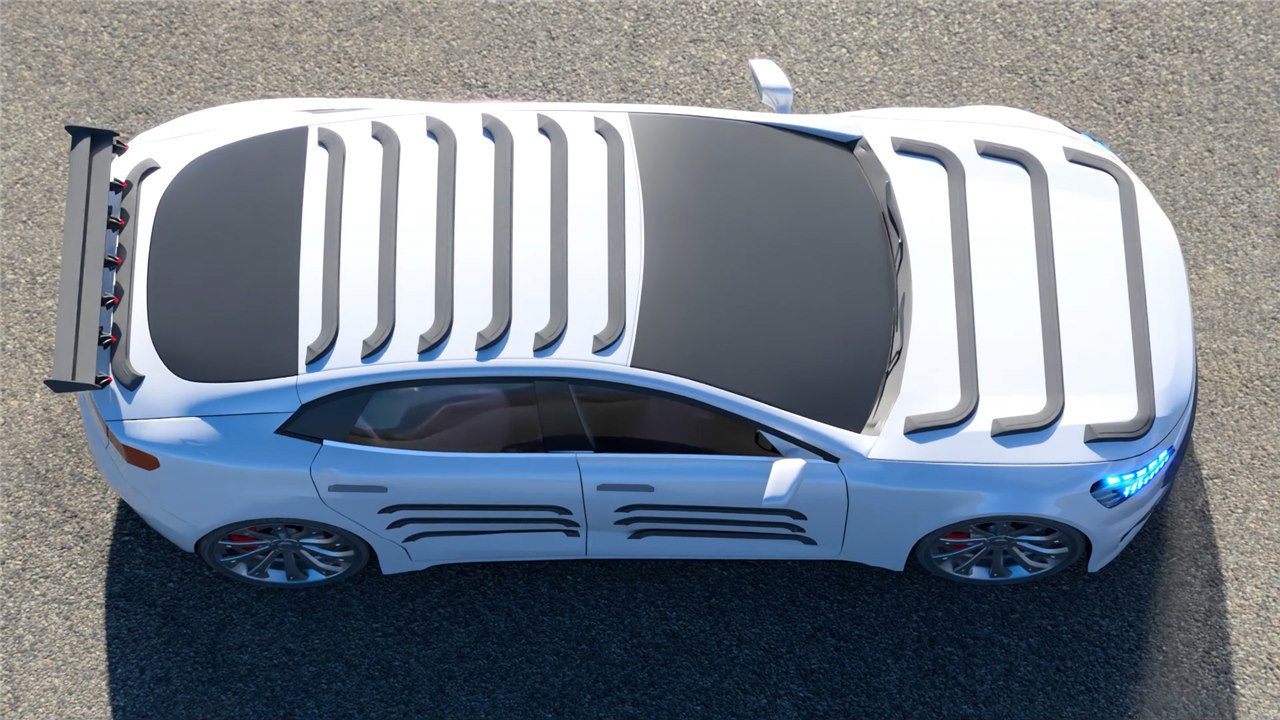
Turning Road Speed Into Charge: Inside the Wind Car
By For Sale By Inventor, on behalf of inventor Michael A. Davis
Electric vehicles and plug-in hybrids are no longer unusual on American roads. They deliver nearly all the benefits and functionality of conventional fossil-fuel vehicles while cutting air pollution, running quieter, staying easier to maintain, and matching or exceeding gas-powered vehicles on power. On almost every axis the comparison has closed.
Almost. The exception is refueling. Recharging an electric vehicle takes hours where a conventional vehicle takes several minutes at a pump, and that single difference severely limits continuous operating range on electric power alone. It is why manufacturers stay on constant lookout for anything that improves efficiency and lets a vehicle operate for longer times over longer distances. Inventor Michael A. Davis built the Wind Car to address exactly that need.
The Wind Car, as the name implies, is an apparatus that produces electrical power for an electric or hybrid vehicle as it moves. The design uses a series of wind turbines located inside a series of tubes routed from the front to the rear of the vehicle. Those turbines drive alternators, which generate electricity once the vehicle begins moving down the road. Under starting, uphill, or low-speed conditions, conventional rechargeable batteries drive motors located at each wheel through a conventional voltage regulator circuit. Once a suitable speed is reached, the turbine array is intended to contribute power back toward driving the motors and recharging the batteries.
- Front-to-rear tube routing. Tubes carry airflow through the vehicle body rather than mounting hardware into the slipstream as an external add-on.
- Turbine and alternator pairing. Each turbine drives an alternator; output rises in ratio to vehicle speed.
- Scalable array. Additional tubes with turbines and alternators are added according to the power needs of the host vehicle.
- Standard components. Batteries, turbines, charge controllers, drive motors, and interconnects are readily available industrial parts from existing wholesalers.
- Straightforward assembly. Relatively simple construction with low material and labor cost, suited to manufacturing workers of average skill.
On the manufacturing side the picture is unusually clean. Every material required to produce the Wind Car is well known to manufacturers working in this category. The work an engineering design team would take on is coordination — matching turbine output to the charging requirements of the battery pack and to the operating characteristics of the drive motors. The discrete components are best procured from wholesalers and manufacturers that already deal in goods of that nature, then assembled in final location. Low material and labor costs follow from the simplicity of the design.
The Wind Car is patent pending, a prototype has been built, and a complete product specification is on file. Inventor Michael A. Davis is seeking manufacturing, retail, wholesale, distribution, and licensing partners, and the full technical package is available to qualified parties under appropriate agreement. Contact us now to start that conversation.


